
Emotional Vocabulary Is a Learned Skill
"A child who cannot say frustrated will show you frustrated instead."

Your three year old is on the floor. Something happened — the cracker broke, the sock felt wrong, their sister looked at the toy. You ask what is wrong and you get a sound, not a sentence. You are not dealing with a behavior problem. You are dealing with a translation problem.
Between the ages of three and five, children feel the full adult range of emotions — frustration, disappointment, jealousy, anxiety, embarrassment — with a vocabulary that mostly tops out at happy, sad, mad. The feeling arrives at full volume. The word to describe it has not been built yet. So the feeling comes out the only way it can: through the body.
Emotional vocabulary for kids is the bridge. It is the set of words a child can reach for when something big is happening inside them, and it is one of the most reliable predictors of how a child handles hard moments — not just at four, but at fourteen.
"You are not trying to talk your child out of a feeling. You are trying to hand them the word for it. A feeling with a name has somewhere to go besides the floor."
In this guide we walk through what emotional vocabulary actually is, why children fall apart when they cannot find the words, what genuinely builds feelings words at this age, and the everyday moments where the skill gets built. Grounded in developmental science. Written by a physician. For real parents in real moments.
What Emotional Vocabulary Really Is
Emotional vocabulary is not a list of feelings words a child can recite. It is the ability to notice an internal state and attach an accurate word to it, in the moment it is happening.
Those are two very different skills. A child can point to the "angry" face on a feelings chart and still have no idea that the hot, tight thing in their chest when the block tower falls is that same feeling. Recognition is the easy half. Retrieval under pressure is the half that matters.
Here is why it changes behavior so directly. When a person names an emotion out loud, activity in the brain's threat center decreases and activity in the region responsible for regulation increases. Researchers at UCLA call this affect labeling, and it is one of the more robust findings in the emotion regulation literature.
"Name it to tame it" is not a parenting slogan. It is a description of what the nervous system actually does.
For a young child this is a genuinely demanding task. They have to feel something, hold it long enough to examine it, sort it from the other things they are feeling, and find a word — all while flooded. Most three year olds cannot do this without help. Most five year olds can do it some of the time, if someone has been feeding them the words for a couple of years.
That growth curve is steep, and it is almost entirely driven by exposure. Children do not discover feelings words on their own. They get them from the adults around them.
Source: Ridgeway, D., Waters, E. & Kuczaj, S.A. (1985). Developmental Psychology. Widen, S.C. & Russell, J.A. (2008). Harvard Center on the Developing Child. Individual children vary widely — exposure matters more than age.

Why Children Fall Apart When They Cannot Find the Words
There is a window in early childhood where a child's emotional experience runs years ahead of their emotional language. They feel everything. They can say almost none of it.
The feelings that cause the most trouble at this age are rarely sad or mad. They are the layered ones — the ones that need a specific word:
Every one of those has a distinct internal signature, and every one gets collapsed into the same output when the word is missing. The child says "I'm mad" — or says nothing and hits the table — because mad is the only container they own big enough to hold it.
What it feels like inside
What you can say
This matters more than it sounds. When a child mislabels disappointment as anger, the adults around them respond to anger. The child gets corrected for a feeling they were not actually having. Over time that mismatch teaches them that their inner world is confusing and that describing it does not help much.
When the word is not available, the feeling still has to go somewhere. It exits through the body. That is what most "behavior" at this age actually is.
4
Common exits
Source: Denham, S.A. et al. (2003). Child Development. Zero to Three, Tuning In National Parent Survey (2016). American Academy of Pediatrics. Proportions are illustrative based on published research findings and vary by child and setting.
What Emotional Vocabulary Is Not
A lot of well-meaning advice in this space quietly turns into pressure. It helps to be clear about what this skill is not.
That last point is the whole ballgame. Emotional vocabulary is transmitted, not discovered — and the method of transmission turns out to matter a great deal.
Source: Denham, S.A., Bassett, H.H. & Wyatt, T. (2007). Brownell, C.A. et al. (2013). Infancy — shared book reading and emotion talk. Harvard Center on the Developing Child, Serve and Return. Ranges are illustrative based on published research findings.
Build the words before they are needed
The words are the skill.
We made a deck that hands them over.
My Magical Animals™ turns feelings words into a five minute ritual your child asks for — an animal, a feeling, and a simple prompt that gets the word out of the card and into their mouth.
How to Teach Kids to Name Feelings at Home
None of this requires a program. It requires a habit, repeated in small doses, on ordinary days. Four things do most of the work.
1. Narrate your own feelings first. "I'm frustrated — this jar will not open." "I felt nervous before my meeting." Children learn feelings words the same way they learn every other word: by hearing an adult use them accurately, out loud, about something real. This costs you nothing and it is the single highest-yield habit on this list.
2. Offer the word, do not demand it. "You look disappointed" gives a child something to try on. "How are you feeling? Use your words" asks a flooded three year old to perform a skill they do not have yet. Offering builds the vocabulary. Demanding builds resistance.
3. Teach in the calm, not in the storm. The middle of a meltdown is the worst possible classroom. Do the naming practice at bedtime, in the car, over snack — when the nervous system is settled and the language centers are actually available. Then the word is there when it is needed.
4. Use a character, not the child. Young children talk about hard feelings far more freely when the feeling belongs to someone else — a bear, a rabbit, a picture in a book. "Why do you think the elephant feels shy?" gets you a real conversation. "Why did you feel shy?" usually gets you a shrug.

Everyday Moments Where the Words Get Built
You do not need extra time in the day. You need about ninety seconds, attached to something you already do. These are the moments that work best — because the child is calm, close to you, and not being asked to perform.
No eye contact required, which lowers the stakes considerably. "Something at school made you quiet today." Then wait.
Warm, contained, unhurried. A good place to replay a hard moment from earlier — now that everyone can think again.
Five minutes, side by side. This is where a feelings-card ritual fits naturally without becoming a lesson.
"What was one moment today that felt big?" Ends the day with the message that feelings are discussable.
Whatever the moment, the shape of the conversation is the same. Three steps, in order, every time.
- "Your shoulders went up when we walked in."
- Describe bodies, not motives — no "you were being rude"
- This signals you are paying attention, not building a case
- "I wonder if that was nervous. Lots of new people at once."
- Offer it as a guess so your child can correct you
- Being corrected is a win — they just sorted it themselves
- "I get nervous in new rooms too. It gets smaller after a while."
- Share your own version of the feeling, briefly
- Name the fact that it ends — this is the part that reassures

Do this a few times a week and you will notice something around the six to eight week mark: your child starts using the word before the meltdown instead of after it. That is the whole goal. It is not that the hard feelings stopped. It is that they finally have somewhere to go.
"How do I get my child to use their words?"
"Which words has my child actually been given?"
That single shift — from demanding to supplying — changes what you say in hard moments, what your child learns from them, and how quickly they recover the next time. You cannot ask a child to reach for a word you have never handed them.
"Every feelings word you give your child
is one less thing they have to say with their body.
Emotional Intelligence Activities for Kids: Building the Words Before They Are Needed
The most effective way to build emotional vocabulary is not a chart on the wall. It is a short, repeatable ritual with an adult, in a calm moment, using a character the child cares about.
That is the whole mechanism behind every finding in this article: a feeling gets a name, attached to a story, with a trusted grown-up beside it. Repeat it often enough and the word becomes available when the feeling actually arrives.
This is what My Magical Animals™ was designed for. Not as a lesson. As the five minutes before bath time that quietly builds the vocabulary your child will reach for at four, at nine, and at sixteen.
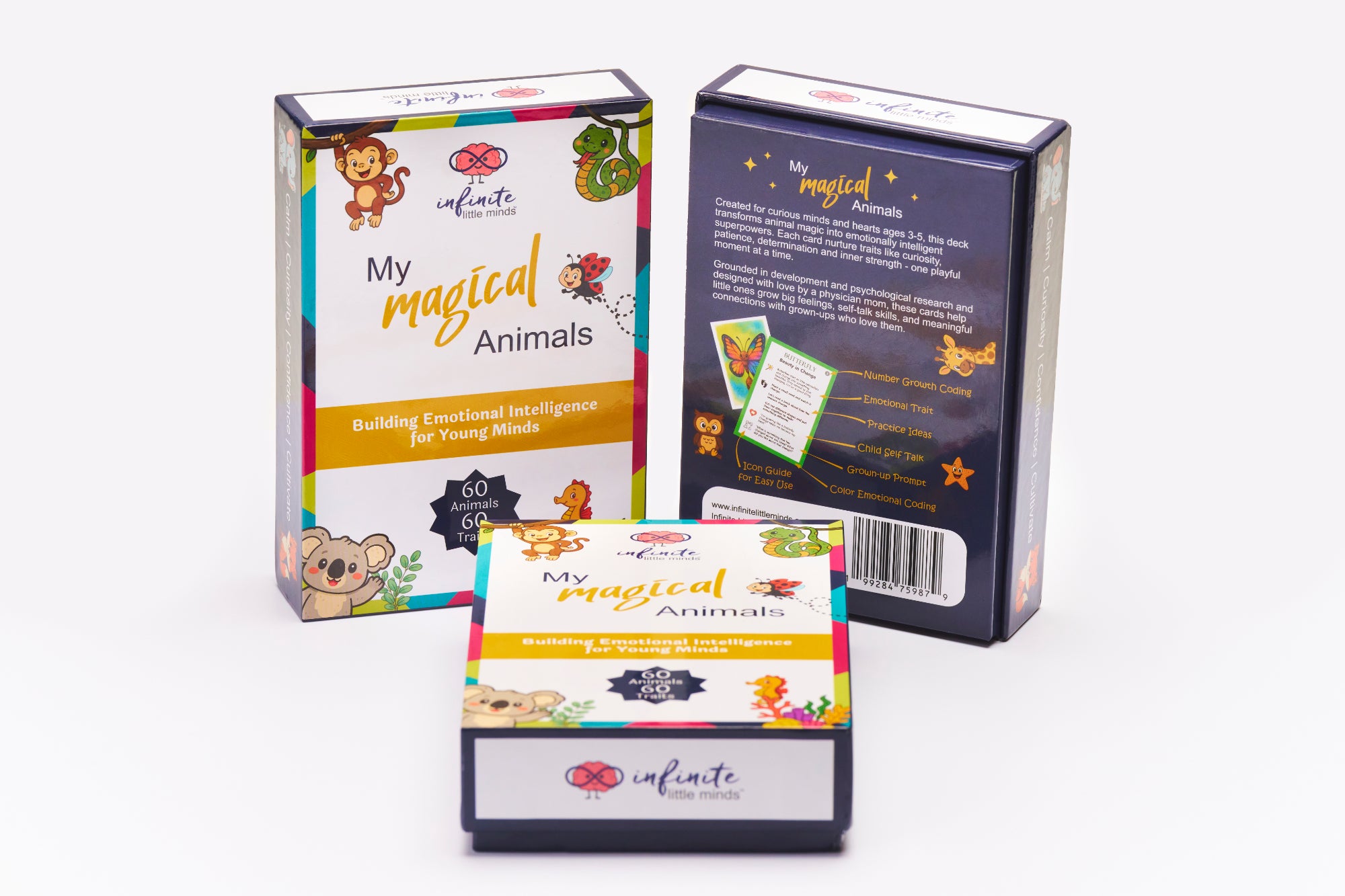
My Magical Animals™ Flashcards
60 Cards. One Meaningful Deck.
A physician-designed, science-backed social-emotional learning experience for children ages 3 to 6+ — embedded in play, rooted in science, built for real parenting moments.
Why physician-designed matters
Every card is grounded in developmental psychology and pediatric clinical research. Dr. Anju, MD — Internal Medicine Physician, CMO, and mom of two — designed these cards because she sees daily what happens when emotional intelligence isn't built early. Referenced by Harvard and the AAP.
What parents are saying
"My daughter used the word disappointed at dinner. Correctly. She's four. Two weeks ago her only setting was screaming."
— Verified Parent"He asks for the animals now. It's become the five minutes before bath that we both look forward to, and he's naming feelings I didn't know he had."
— Verified Parent"I've bought a lot of feelings charts. This is the first one my son actually engages with instead of ignoring on the wall."
— Verified ParentStart building the words today
Give your child the word before
they have to show you the feeling.
My Magical Animals™ works in 5 minutes a day, in ordinary moments — bath time, car rides, bedtime — building the emotional vocabulary that makes every hard moment a little more familiar.
Save this for later: When Big Feelings Show Up
A free, printable parent guide — the feelings words by age, the sentences that actually land, and what to say when "use your words" isn't working.
The free guide includes:

Dr. Anju, MD
Internal Medicine Physician · Chief Medical Officer · Mom of TwoI have spent years caring for adolescents, adults, and the elderly — people navigating the medical, emotional, and social consequences of patterns that began in early childhood. Over time, I found myself asking the same question again and again: how did we get here?
When I became a mother, the answer arrived. Not gently. In the most honest and humbling way possible. I realized that the emotional intelligence we hope to find in our adult patients — self-compassion, empathy, resilience — is built or broken in the very first years of life. In the ordinary moments. By the adults who show up.
That is why I created Infinite Little Minds. Not as a product. As a purpose.
Read My Full Story Here →Sources
References
This article is educational and is not a substitute for individualized medical or developmental advice. If you have concerns about your child's language or emotional development, speak with your pediatrician.